Review: Heaven, Hell, and Purgatory: Rethinking the Things That Matter Most by Jerry L. Walls
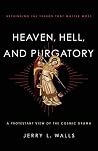 Heaven, Hell, and Purgatory: Rethinking the Things That Matter Most by Jerry L. Walls by Jerry L. Walls
My rating: 3 of 5 stars
*SPOILERS IN REVIEW*
Jerry Walls undertook the challenging task of deep diving into the concept of the afterlife from a Christian perspective, even more as a protestant. The professor of philosophy holds up to his title by following the path of the afterlife from a philosophical view and brings in big names in its world like Aristotle, Pascal, Nietzsche, and many more. Now, these philosophers that he has mentioned have both religious and atheistic viewpoints, which he uses to bring up his defense for the afterlife.
The focus of the first chapter is on the nature of heaven, the Trinity, and the way of life. Through this chapter, he goes on to say that to even grapple with the idea and place of Hell and/or purgatory; we must first understand Heaven and the way that the Triune God grants us passage through the act of Salvation. The second chapter focuses on a consolidation of the dreams that we have for the afterlife, and this chapter goes on to say that while dreaming is a beautiful thing to do, we must also hold steadfast to the idea that Heaven is real. While we may not be able to see it with our human eyes, we may still dream of the beauty of it once we can reach it.
The third chapter hits the very questions that plague secular and religious alike when the concept of hell is mentioned: “If God is Love, why is there a hell?” (Walls, 67) Walls rightly details that there is a hell because God is Love and that hell itself is a place where people who have rejected the love of God go. That the Triune God does not force anyone to the love he provides and that they are “free” to reject that love, but from that rejection, Rob Bell is quoted as, “We are free to resist, reject, and rebel against God’s way for us. We can have all the hell we want.” (Walls, 73) The fourth chapter mainly speaks on the protestant stance on purgatory, wondering why such a place is needed if the grace of God is sufficient. For this chapter, Walls reflects strongly on C.S. Lewis’s writings, whom he calls the “Highly regarded Protestant thinker and writer” (Walls, 99), and tells how Lewis believed in Purgatory and that Protestant Christians needed to believe in it as well since it is the place where the saved may clean themselves to the point of perfect from the impurity that has endured as a sinner on earth. Walls backs up Lewis on this point and takes a stance to say that purgatory is the place where we can meet the point of sanctification and inner purity as we try to enter the kingdom of God.
The fifth chapter of the book dives deeper into the concept of the afterlife and what comes of the problem that evil brings. When evil strikes in the hearts of many, the question arises of how God will bring justice to the victims and how it is possible that He can extend mercy to the perpetrators. He explains how the Lord extends mercy and the ability to repent to all during their earthly life. That those who have suffered can see the beauty and grace that God will extend in heaven. Chapter seven goes on to direct the audience to the ultimate motivation to live a moral life with the Triune God, that we as humans must look to live our lives per the morals that we have been directed to. The concluding chapter reiterates an earlier claim that Christians must have belief in the place of purgatory. Now, he focuses on this chapter mostly on the myths of purgatory that are said between the protestants and says that purgatory isn’t a second chance for the unrepentant but a place where the saved may cleanse themselves further from the sins that have dirtied their souls before they can go and rejoice in God their savior. He also makes a small reflection of scripture that refutes his claim on the place of purgatory as merely not what the verses are trying to convey in his perspective or interpretation and finally, reclaiming his defense, saying that purgatory is the place for those who are sorry to be cleansed and to enter into glory.
If I were speaking from a philosophical worldview, this book gives a good defense of the concept of the afterlife and that there is so much more to see that is preached Sunday to Sunday. What I have summarized is not nearly the full scope of what Jerry Walls has detailed in his book, and I cannot fault him since his claim is well-defended. He brought in the questions, and instead of leaving them in the air throughout the book, he answered them directly. He held strong to the notion that the ultimate reality known as God is graceful and loving, and through that, love offers sinners a way to enter his holy grace and joy that is found in heaven.
However, speaking from a protestant theological standpoint, I would have to say that this is found wanting. Throughout the book, Walls reflects on the goodness of God and the impurity of sin with the concept of heaven, hell, and purgatory. Now, purgatory is a “fighting term,” as Walls would say, and it is true since there are high opinions about the place of purgatory in the Christian faith. But throughout the book, when Walls explained purgatory, he didn’t defend the place based on scripture; he would remark or vaguely speak on biblical themes and understanding but not give concrete verses where scripture affirms the reality of purgatory. He does reflect on the verses that would normally be used to discredit purgatory, such as Hebrews 9:27-28 and Luke 13:23-30 but says that they do not speak on postmortem intervention.
That notion possibly shows eisegesis instead of exegesis in the biblical text, which defends that after death, the Lord brings judgment upon the souls. He makes multiple references from the book of Revelations to speak on Heaven and Hell and how these are real places that affect the lives of believers and unbelievers, and that is commendable. However, when making a book on Christian terms and ideals, one must also consult faithfully to the text that the Christian belief holds dear since we view scripture as infallible and inerrant. His focus on C.S. Lewis and his writings is great, but there are much more prominent and highly regarded theologians who give their expert opinion on purgatory and would have multiple counterclaims to the idea that a place like that does exist.
View all my reviews


Comments
Post a Comment